Others automate support.
GLUCOSE owns the experience.
Most AI vendors orchestrate tickets - routing a contact to the right flow, the right queue, the right script. GLUCOSE orchestrates agents - autonomously planning, reasoning, and switching between brand, product, sales, and support personas across the full customer lifecycle, with no decision tree to run out of branches.
Deterministic tools automate flows.
GLUCOSE orchestrates outcomes.
Most AI vendors in this category lead on brand recognition and muscle - but carry high TCO, vendor lock-in, and a support-scoped mandate with little incentive to hand customers full autonomy upstream of the contact centre. GLUCOSE was built for a different mandate from day one - the six ways that shows up in practice, below.
Effort
Every intent, branch, and fallback mapped by hand. A 6–12 month build that becomes a permanent maintenance burden the moment a product or offer changes.
Configure a Corpus and a goal once. GLUCOSE reasons the path itself - no flowchart to redraw every time the catalogue does.
Personalisation & context
One script, every user. Context resets at every branch - nothing carries forward unless a designer hardcoded a node for it.
Full conversational memory. Responses adapt to history, interests, and lifecycle stage - for context no one thought to script in advance.
Edge cases
Anything outside the mapped branches is a dead end - “I can only help with one thing at a time.” Every edge case becomes a new engineering ticket.
Reasons through unanticipated questions using the Corpus and defined goals. No dead ends, no backlog of “the bot couldn’t handle it.”
Linear vs. non-linear
Assumes one topic, one path, at a time. A user asking two things at once - an address change and a warranty question - breaks the flow.
Pursues multiple goals in parallel, in any order the customer raises them - handling non-linear, multi-intent conversations natively.
Scalability
Every new product, market, or channel means new flow diagrams and a new QA cycle. Cost grows linearly with scope.
One Corpus, one set of Journeys, deployed across every channel and market at once. Marginal cost per new use case approaches zero.
Testing & evals
QA means manually walking every branch once, before launch. No visibility into quality drift once it’s live.
Continuous per-turn evaluation against the same metric set from pre-deployment QC through live production - drift caught before a customer notices, not after.
The same six differences, at a glance.
Swipe to compare →
| Axis | GLUCOSE Orchestration | Logic Flows |
|---|---|---|
| 01 - Effort: configure once vs. hand-map every branch | ✓ | ✕ |
| 02 - Personalisation & context: full memory vs. context reset per branch | ✓ | ✕ |
| 03 - Edge cases: reasons through the unmapped vs. dead-ends outside the tree | ✓ | ✕ |
| 04 - Linear vs. non-linear: multi-intent in parallel vs. one topic at a time | ✓ | ✕ |
| 05 - Scalability: one Corpus, every market vs. new flows per market | ✓ | ✕ |
| 06 - Testing & evals: continuous live scoring vs. one-time pre-launch QA | ✓ | ✕ |
See the six axes explained in detail above.
One planner. One orchestrator.
Every customer, automatically routed to the right agent.
GLUCOSE runs two always-on reasoning layers above every conversation - deciding not just what to say, but which agent should be saying it, and when to say it without being asked.
Agent personas
- Brand Ambassador
- Product Expert
- Customer Support Representative
- Sales Consultant
Journeys
- Greetings & Onboarding
- Step-by-step Instructions
- Troubleshooting
- Service Booking
- Road Assistance
- Test-Drive Request
- Product Showcase & USPs
Autonomous Planner
Plans and executes contextual re-engagements based on user signals, drop-offs, and deferred actions - protecting CSAT and CLV over time, without a human ever queuing a follow-up.
Autonomous Orchestrator
Switches between Experience Agent personas based on user context, intent, and needs - mid-conversation and across conversations - with no handoff friction.
Journeys are the unit of orchestration. Each Journey is a fully equipped AI agent configured with its own Tools, Goals, and Instructions - assembled by your team in the GLUCOSE Management Console, not hand-coded by engineers.
Explore AI Experience AgentsGLUCOSE handles the conversation.
Your team stays in control.
Orchestration without oversight is a liability. Every GLUCOSE deployment ships with a live console that gives supervisors full visibility and one-click override - with zero disruption to the autonomous flow underneath.
Live Conversation Monitor
Every active thread across all channels visible in real time - message history, channel, and engagement status at a glance.
Automated User Profiles
Interests, GLUCOSE Score, active agents, and AI-generated status summaries - assembled from conversation context, not manual entry.
Per-Turn Eval Scores
Every agent response scored live against your brand metrics - tone, clarity, booking confirmation, brand voice - flagged below threshold.
Take Over · Blacklist
One-click human override: assume control of any live conversation or block a contact - surgical intervention without rebuilding any workflow.
GLUCOSE operates fully autonomously. Supervisors can monitor every conversation, take over at any moment, or blacklist contacts - without disrupting the AI flow.
Eval metrics. Three phases.
One quality contract.
Autonomy without reliability is a liability. GLUCOSE runs a continuous evaluation pipeline that anchors quality at every stage - from pre-deployment QC, through client UAT sign-off, to live runtime intelligence in production. It's the same engine, the same metrics, at every gate - which is what makes autonomy something you can actually trust in production.
Quality Control. Pre-deployment.
Stress-test every AI Experience Agent before releasing it to a single real user. Every configuration is validated against a defined set of synthetic and adversarial test cases - Eval runs interrogate the Corpus, the guardrails, and the agent logic before exposure.
User Acceptance Testing. Go-live.
Go-live is a signed-off document, not a handshake. The Eval Framework runs against a large set of test scenarios and personas - sign-off is structured, evidence-backed, and contractually anchored, never a verbal “looks good.”
Runtime Intelligence. Always-on.
Every user conversation is a live evaluation. The Eval Framework never stops - continuously scoring using the identical metric set from QC and UAT to detect quality drift, generate real-time analytics, and build rich first-party data assets.
Every lead, booking, and conversion -
captured without a single form.
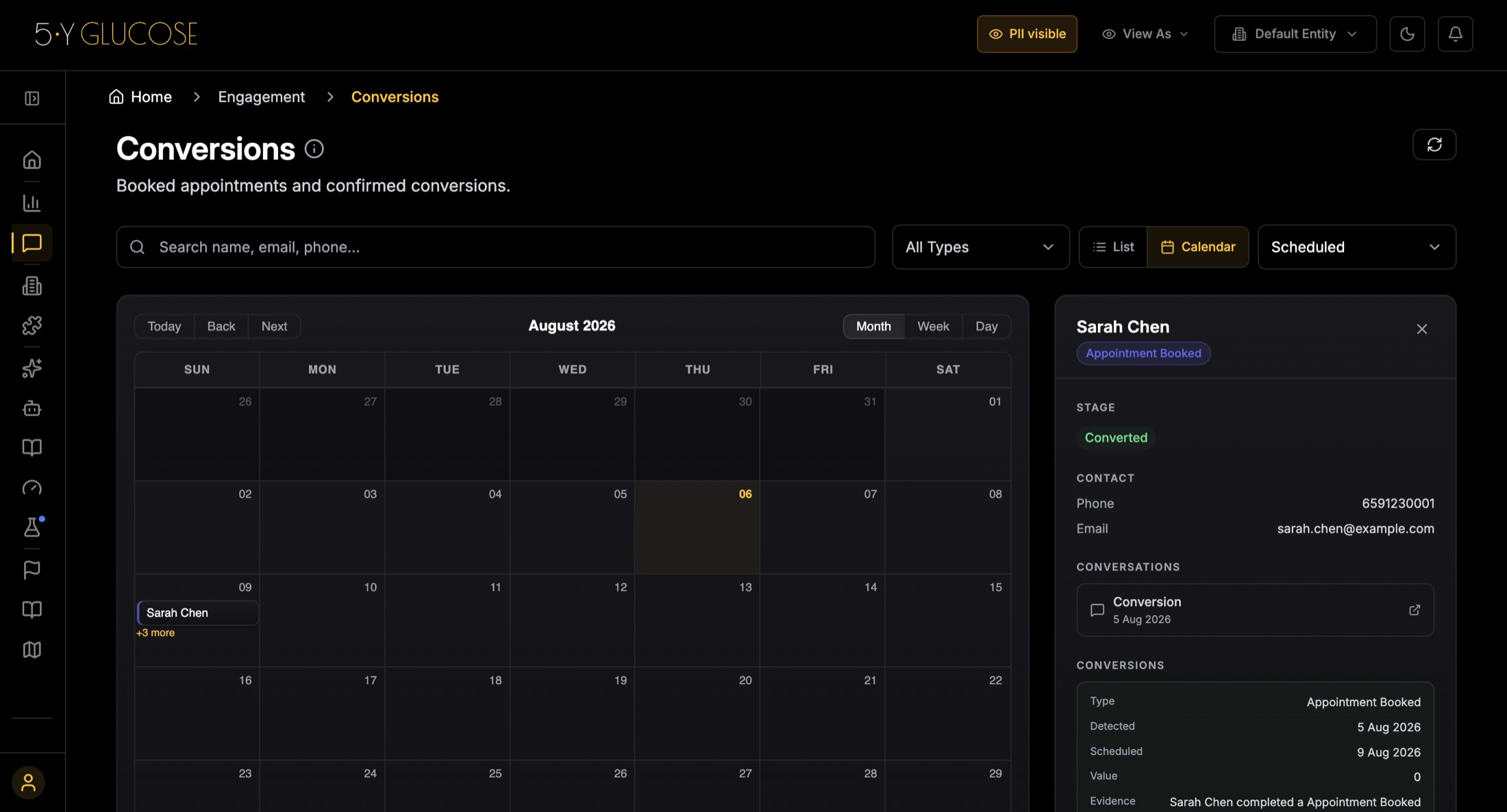
GLUCOSE classifies, qualifies, books, and attributes every contact. Channel, interest, value, and funnel stage are all inferred from the conversation - never typed, tagged, or scored by hand.
Autonomous Lead Qualification
Every user classified Awareness → Consideration → High Interest → Converted by the agent - no human scoring required.
Calendar Conversion View
Booked appointments as a full calendar or filterable list - each showing channel, detection date, scheduled date, and monetary value.
Conversion Evidence
Every confirmed booking carries a verbatim conversation extract proving the AI detected intent and confirmed the appointment.
Channel Attribution
Inbound channel captured per lead - WhatsApp, Facebook, Instagram, Web - source attribution with zero extra analytics tooling.
What orchestration means at each layer
Routes an existing problem to the best available resource. Scoped to the support moment.
Routes the entire customer relationship to the right autonomous agent, at the right lifecycle moment - before, during, and long after any support need exists.
Orchestration inside the contact centre reduces cost.
Orchestration upstream of it generates revenue.
CCaaS orchestration platforms route a ticket to the right queue after a customer already has a problem. GLUCOSE orchestrates the relationship before that - acquisition, onboarding, ownership, upsell, repurchase - so fewer customers ever generate a ticket in the first place, and every interaction that does reach support arrives with full context already captured.
The result isn’t a lower cost-per-contact. It’s a customer base that converts, retains, and re-purchases at a higher rate - measured in pipeline, not average handle time.