One quality contract
behind every agent.
A continuous evaluation pipeline that anchors quality at every stage - pre-deployment QC, client UAT sign-off, and live runtime intelligence. One engine, every gate: the same scoring framework from configuration to production.
Phase 01 · QC - Pre-deployment
Quality control before a single real user. Synthetic and adversarial stress-testing of the corpus, guardrails and journey logic.
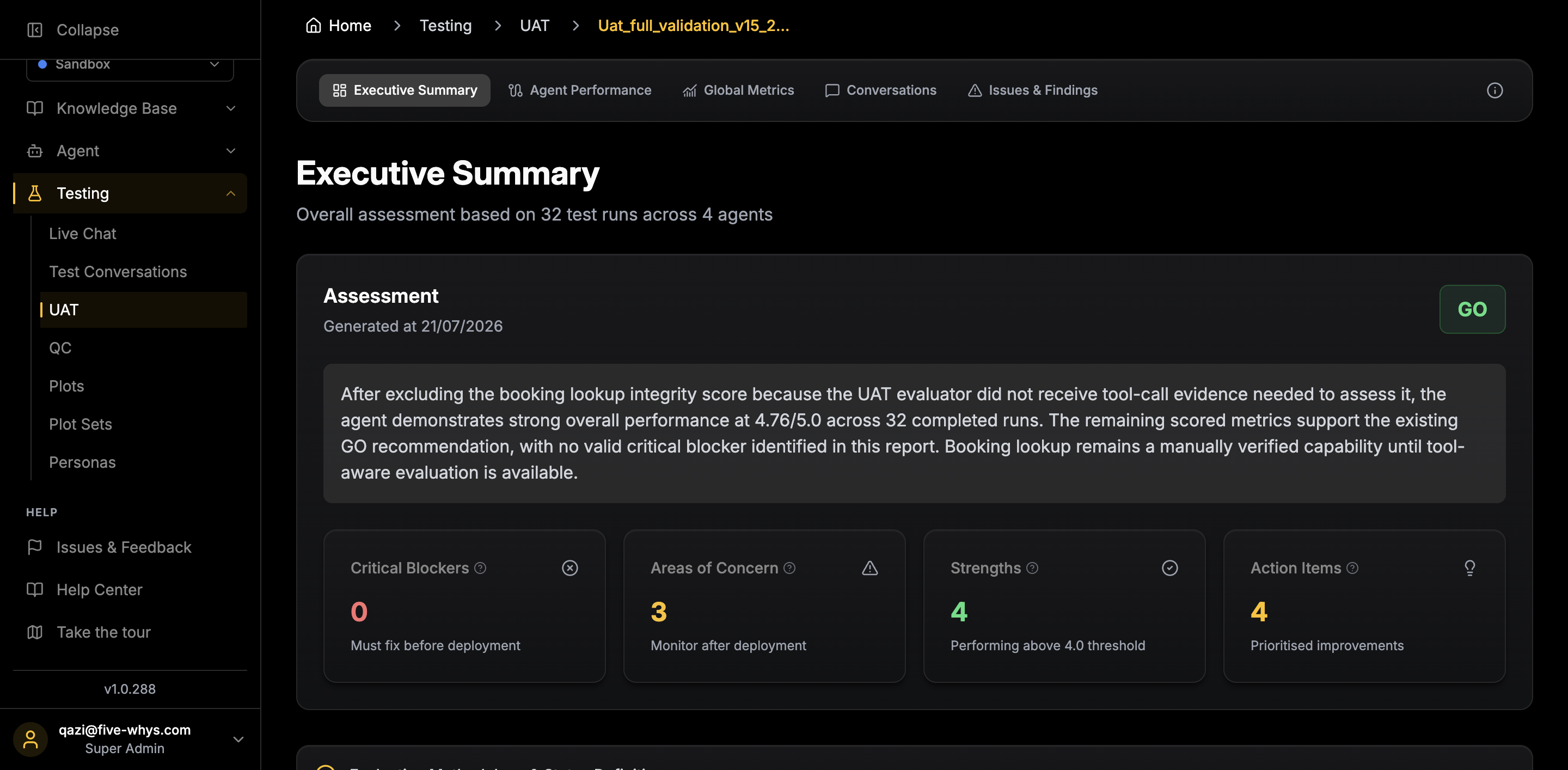
Phase 02 · UAT - Go-live
Client-facing acceptance testing against real scenarios. Go-live is a signed, evidence-backed document - not a handshake.
Phase 03 · Runtime - Always-on
Every production conversation scored live. Drift detected before users feel it; 1st-party insight feeds the next iteration.
A continuous quality pipeline - pre-flight to production.
Quality is not a final-stage gate. The Eval Framework runs the same metric vocabulary across three phases, so every score is comparable end-to-end.
Pre-deployment Quality Control
Internal stress-testing against synthetic and adversarial cases - validates corpus, IGD guardrails and journey logic before a real user ever interacts.
User Acceptance Testing
Client-facing validation against real scenarios and stakeholder conversations. The UAT report is a formal go-live milestone - not an internal handshake.
Live Intelligence
Continuous scoring of every production conversation - drift detection, drop-off analytics, sentiment trends and 1st-party insight feeding the next cycle.
Every score, comparable end-to-end.
Response Quality
- Accuracy & factual grounding
- Relevance to user intent
- Completeness of answer
- Citation traceability
Brand & Safety
- Guardrail (IGD) compliance
- Tone & brand-voice alignment
- Policy & legal boundaries
- Adversarial robustness
Conversational
- Coherence across turns
- Context retention
- Linguistic fluency
- Disambiguation behaviour
Journey Performance
- Goal completion rate
- Step efficiency
- Escalation rate
- Drop-off attribution
Sentiment & Intent
- Sentiment trajectory
- Intent classification
- CSAT & NPS modelling
- Frustration & recovery
Agent Behaviour
- Autonomy level
- Reasoning-chain quality
- Tool-use appropriateness
- Instruction adherence